
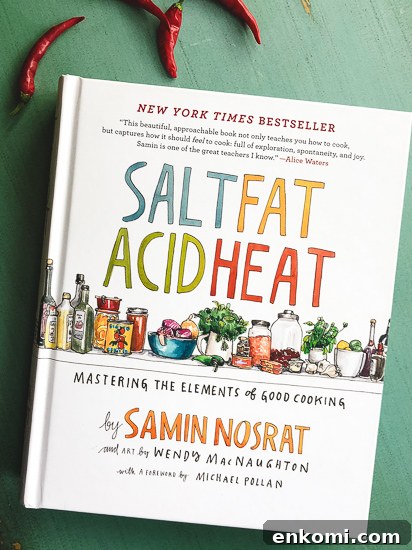
Sat Fat Acid Heat by Samin Nosrat – not just recipes, but how to use the four components: salt fat acid and heat to improve your cooking. An excellent resource for the home cook and amateur chef!
Post may contain affiliate links, full disclosure on side bar.
Becoming a Better Cook
Recently I found myself frustrated with my cooking. I relied heavily on recipes and followed instructions without really understanding why certain steps or ingredients mattered. After years of cooking I have a solid grasp of basics, but I still reached for a squeeze of lemon simply because a recipe told me to, not because I knew what that acid would do for the dish.
My interest was piqued while watching a cooking competition where judges and chefs repeatedly asked contestants to add more acid, or more salt, or to change the way they handled heat. The contestants often seemed to instinctively know how to work with an ingredient, while I would reflexively go hunting through my collection of cookbooks to find a pork chop recipe when pork chops landed on my counter. What I wanted was the confidence to look at an ingredient and know what to do with it without having to look it up.
So I searched for a book that teaches the principles behind good cooking. Fortunately, one arrived at just the right time.
Salt Fat Acid Heat by Samin Nosrat
Salt Fat Acid Heat by Samin Nosrat feels less like a typical cookbook and more like a practical culinary textbook. It’s substantial—462 pages—with lined pages at the back for notes. Instead of glossy photos, charming illustrations guide you, and the recipe section doesn’t begin until the latter half of the book. Calling it merely a cookbook understates its purpose; it reads like a chef standing beside you, explaining the reasoning behind techniques and flavor decisions.
The book is organized into two main parts. Part One explains the four foundational elements of good cooking—salt, fat, acid, and heat—while Part Two offers recipes, kitchen basics, recommended techniques, and suggested reading.
Part One – The Four Elements of Good Cooking
Part One dives deep into each of the four elements, explaining what they are, how they function, and how to use them confidently. The salt chapter, for example, includes sections such as what salt is, how salt affects flavor, how salt works in various preparations, and practical guidance on when and how to salt. A particularly useful feature is the salting calendar, which gives precise timing recommendations—like salting a turkey two days ahead, a chicken one day ahead, or salting cabbage 15–20 minutes before shredding for slaw.
The fat chapter explores what fat contributes to food, how different fats behave, and how to choose and use fats in cooking. There’s a fascinating two-page foldout on the world of fats that connects regional cuisines with the fats they traditionally use—illustrating, for example, how ghee and coconut oil feature in some Indian cuisines while lard and palm oil appear in others.
The acid chapter became my personal favorite because chefs often call for brightness or balance through acid. Nosrat explains what acid does to flavor, how it interacts with ingredients, and how to use acids like citrus, vinegars, and fermented products to lift and balance dishes.
The heat chapter explains methods from gentle to intense—coddling and poaching, sautéing, searing, roasting, stewing, and braising—clarifying how different applications of heat transform texture and flavor. Together, these sections demystify why recipes work and how to adapt techniques to what’s available in your kitchen.
Part Two – Recipes and Recommendations
Part Two provides recipes, practical lessons, and recommendations for building confidence in the kitchen. It covers essentials like stocks, pantry basics, and cooking techniques, and organizes recipes into categories such as salads and dressings, vegetables, stocks and soups, beans, grains, pastas, eggs, fish, poultry (including “thirteen ways of looking at a chicken”), meats, sauces, breads and doughs, and sweets.
The book balances full, complete recipes with flexible ideas and improvisational suggestions. In the beans section, for instance, Nosrat explains how to soak and cook beans and then offers numerous ways to use them rather than presenting a single prescriptive recipe. She might suggest a simple salad idea—cranberry beans with macerated onions, toasted cumin seeds, feta, and cilantro—or other variations that encourage experimentation.
Salt Fat Acid Heat is the kind of book you return to often. Its clear explanations and practical guidance help solidify the principles behind cooking decisions, so you can confidently adapt techniques and flavors to whatever ingredients you have on hand. I expect to re-read parts of it many times as the lessons sink in and change the way I cook.