
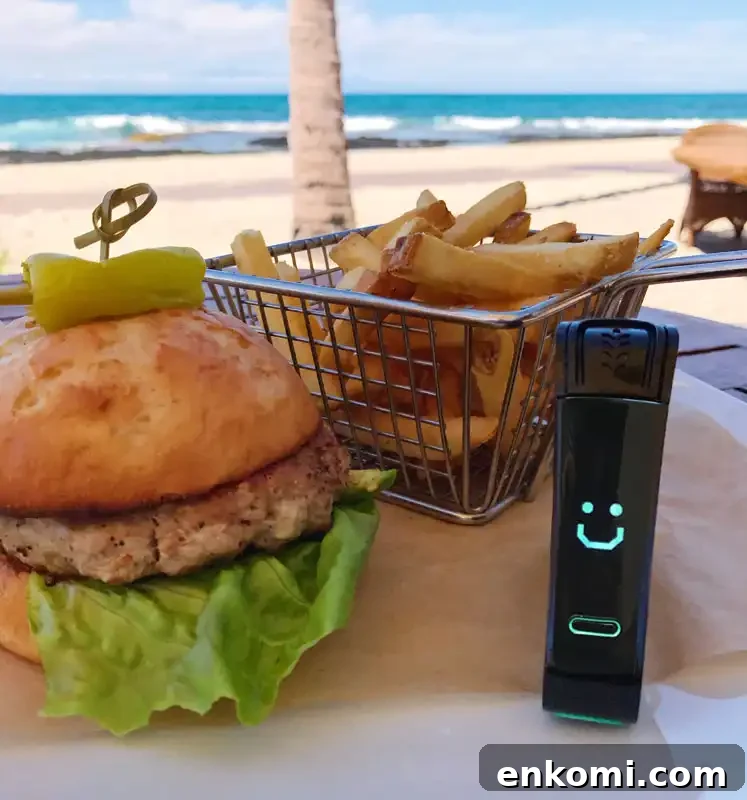
Love me a smiley face!
If you’re unfamiliar with the Nima Sensor, it’s a portable gluten test device that helps detect gluten in food. It works like a compact chemistry kit: place a pea-sized sample of the food into a capsule, insert the capsule into the Nima Sensor, and in about three minutes the device indicates whether gluten is present. A cheerful smiley face on the screen means “no gluten detected,” which is always reassuring when you’re testing a meal on the go.
We were early adopters of the Nima Sensor. Over a year ago I had the chance to connect with the team at Nima Labs when CEO and co-founder Shireen Yates joined one of our Raising Our Celiac Kids meetings via Skype. She tested food we’d sent and answered questions, which gave me some familiarity with how the device performs. I pre-ordered a Nima and received it last fall. This past February break was the first time we traveled with the Sensor, and the whole family was excited to see how it would help during trips.
For context, my son has celiac disease and has followed a strict gluten-free diet for more than six years. Over time we’ve grown comfortable asking questions, reading menus and ingredient labels carefully, and making cautious judgments about what’s safe. Still, dining out while maintaining a strict gluten-free diet requires planning, and eating every meal away from home for ten days can be stressful. We were traveling with extended family — ten people, two states, and five airports — so bringing the Nima felt like adding another helpful tool to our gluten-free toolkit.
Before the trip we wondered how often we’d actually use the Nima, and how we would respond to different results. The newer Nima Sensors indicate “low gluten” and “high gluten” in addition to a clear or found result; we considered how those gradations might affect our decisions. With the device packed, we started in Napa, California for a cousin’s wedding and then headed to a family vacation in Hawaii.
What we found
The Nima Sensor was especially useful when our usual questions didn’t give us full confidence. Cross-contamination is always a concern in food preparation, and when dining out we typically skip food if we aren’t comfortable with the answers we receive. On this trip, the Nima often helped bridge the gap between uncertainty and confidence.
We used the Sensor frequently at airports and on the West Coast, where dining options and staff knowledge vary. The very first test happened at JFK before boarding — my son wanted something to eat and the safest option seemed to be a smoothie place. Ingredients looked fine, but the staff seemed unsure about gluten-free practices. We trusted our judgment and ordered a fruit smoothie, then tested it: smiley face. A reassuring start.
Nima to the rescue
In Napa the bed-and-breakfast served a large breakfast buffet that initially felt overwhelming. After a quick check, we found an omelette station, roast potatoes and fresh fruit — all safe choices for my son. Staff assured us the items were gluten-free, but we still tested the omelette and potatoes with the Nima Sensor to feel certain. Both tests returned a smiley face, so he ate without worry.
During the wedding weekend and travel days we kept using the Sensor. Everything we tested showed no gluten detected, and my son enjoyed meals without any reaction afterward. At LAX we encountered long delays and tested several meals; repeatedly getting smiley faces added to our comfort level. Without the Nima, we likely would have either skipped some meals or eaten cautiously and then worried afterward about accidental gluten exposure.
Anticipation and limitations
Using the Nima with every meal does take time. Although each test takes about three minutes, when others are already eating it can feel long. There were times we chose not to test because waiting would slow the group down. In Hawaii we also noticed that many hotels and restaurants demonstrated strong awareness of celiac disease and cross-contamination. After calling ahead and noting our needs, staff often handled our requests confidently. With ten people dining together, we sometimes opted to trust the restaurant and our own judgment rather than testing every plate.
It’s important to recognize the Nima Sensor’s limitations. Gluten is not always evenly distributed in a dish, so a small sample may not represent the entire plate. The Sensor is a helpful tool but not a replacement for careful questions, good communication with food preparers, and personal judgment.
Overall, we loved traveling with the Nima Sensor. Being away from home for ten days without full control over ingredients or food prep can be stressful on a restricted diet. Having this extra tool made decisions easier and provided reassurance. Best of all: my son didn’t experience any accidental gluten exposure during the trip.
Discount code for purchasing a Nima Sensor
If you’re interested in buying a Nima Sensor, you can use the promo code HGFF for $15 off a Nima Starter Kit.
Disclaimer: While Nima sponsored this post, the opinions and experiences described here are my own. I acted as an affiliate for the Nima Sensor and may receive a small payment if you purchase a device using the promo code mentioned.